Crypto Whales Using Private Channels: Risks and Opportunities

Surprising fact: recent surveys suggest researchers can now record and classify more than 10,000 deep-ocean vocalizations per year, turning once-speculative questions into measurable data.
This article defines “private channels” as largely inaccessible underwater soundscapes—how large cetaceans communicate below human hearing—so readers land in the right context and not in finance.
Breakthroughs in field recorders and AI are changing how scientists study these signals. That shift creates clear opportunities: improved conservation, richer behavioral insight, and cautious two-way experiments.
It also brings risks: overinterpretation, ethical misuse, and rising ocean noise that can mask signals. The piece will separate signal classification from true translation and flag preliminary claims.
Readers should expect evidence-based reporting on topics such as sperm whale codas, Project CETI results, field pipelines, a humpback exchange case, and emerging policy concerns. By the end, readers will gain a practical understanding of what can be inferred today and where the biggest uncertainties lie.
Key Takeaways
- “Private channels” refers to underwater cetacean soundscapes, not finance.
- New recorders and AI make large-scale analysis possible—and urgent.
- Potential gains include better conservation and behavioral insight.
- Major risks: false claims, ethical issues, and increasing ocean noise.
- The article clarifies classification limits and highlights where more work is needed.
Why “Private Channels” Are Suddenly in the Spotlight for Whales
A shift in tools and theory now puts underwater vocal systems squarely in the scientific spotlight.
History matters: for centuries humans drew firm lines between themselves and other species—first pain, then consciousness, and now language. Those moving goalposts show why language is treated as a final boundary in debates about animal intelligence.
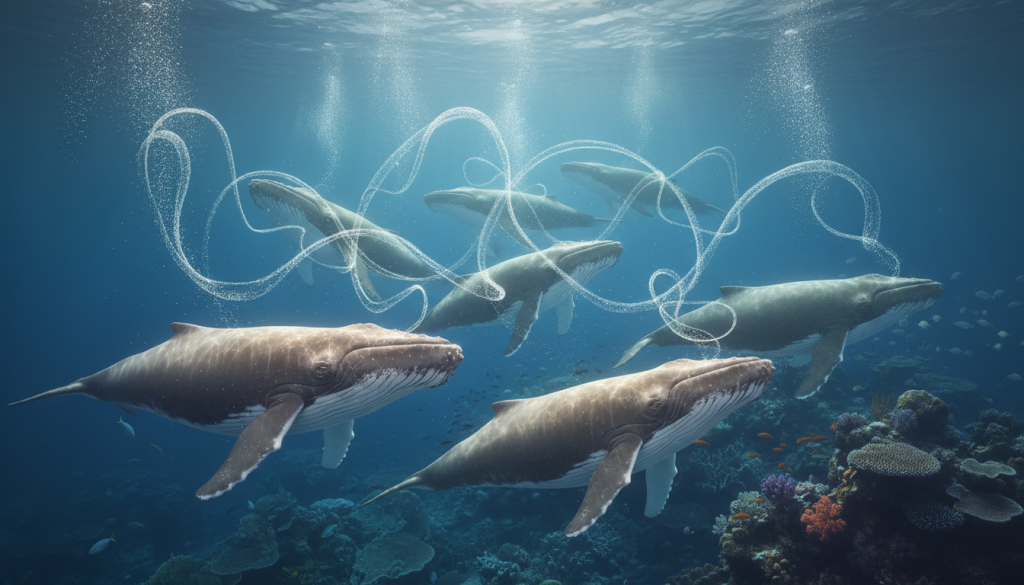
New technology is widening what scientists can test. Project CETI (founded 2020) is a high-profile effort focused on sperm whales. It combines field recordings with artificial intelligence to search for repeatable structure in vocal sequences across years of data.
What AI and robotics add: machine learning scales pattern discovery across massive datasets and suggests testable predictions rather than instant translation.
- Drones, tags, and autonomous platforms improve repeatability in the field.
- Acoustic sensors capture social contexts that let researchers compare calls across groups.
- Better quantification helps policymakers define noise harm and target mitigation.
Caution remains essential: complex structure is not the same as human language, and researchers continue to debate definitions. Still, these advances create a clearer path to rigorous, evidence-based understanding.
Related research and policy threads show how scientific progress can inform regulation and protection.
whales using private channels: What Scientists Mean by Codas, Clicks, and “Morse Code” Bursts
Short, rhythmic click sequences form a repeatable layer of underwater communication that scientists can measure. In sperm whale research, a coda is a brief pattern of clicks—often under two seconds—that acts as a basic unit of social signaling.
Descriptions likening codas to “morse code” help convey timing and rhythm, not letter-by-letter encoding. The metaphor highlights regular intervals and rapid bursts of clicks rather than a literal alphabet.
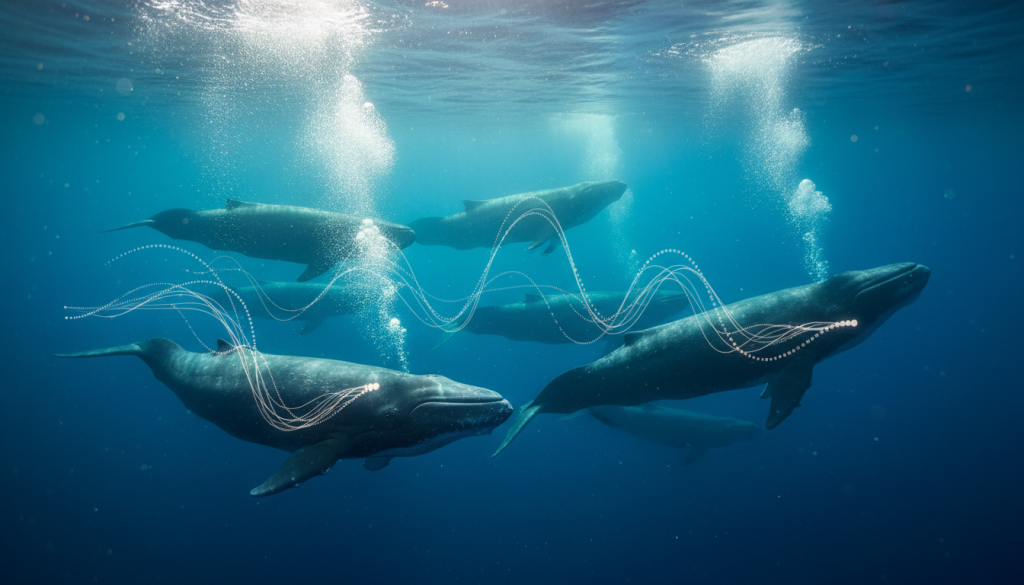
Contrast matters: humpback songs are long, melodic, and evolve across seasons. Dolphin whistles tend to be individually distinctive. These differences show how varied marine sounds map to social roles.
Below the surface, social layers shape meaning: matrilineal groups, family bonds, and regional dialects change how a repeated pattern functions. Scientists can catalog structure—timing, rhythm, and sequence—faster than they can assign confident meaning.
- Define: codas = short rhythmic click patterns.
- Clarify: “Morse code” is a timing metaphor.
- Contrast: clicks vs. songs vs. whistles.
- Context: dialects and family networks matter.
Project CETI’s Latest Breakthrough: Decoding the Sperm Whale “Alphabet”
Project CETI reported a cautious but notable advance: thousands of codas from roughly 60 sperm whales were analyzed with artificial intelligence across about 15 years of recording off Dominica.
What the study found
The team described reusable sound parts that behave more like phonemes than a 26‑letter alphabet. That means short, repeatable units can combine in many ways without implying direct word meanings.
New dimensions in coda structure
Two structural features stand out: rubato—small timing shifts that stretch or compress a pattern—and ornamentation—an occasional extra click added around turn‑taking. Simple examples: a slowed beat or a single added click changes the pattern’s flavor.
Why context data matters
Critical context—location, time of day, and ocean temperature—helped researchers see that the same coda can correlate differently across settings. That contextual lens strengthens interpretation and guides future experiments.
- Scale: thousands of codas, ~60 individuals, multi‑year data.
- Limit: structure and variability are clearer, but exact meanings remain unproven.
- Forward step: richer catalogs enable better hypotheses about turn‑taking and social roles.
Inside the Data Pipeline: How Researchers Record Whale Communication
Practical study of marine acoustic signals depends on a disciplined pipeline from deployment to model validation.
Field teams plan deployments to balance coverage and minimal disturbance. Boats coordinate with drones, gliders, and hydrophones to capture long-duration audio. On‑animal tags add proximity and dive metadata that improve signal clarity and context.
Field hardware and what each adds
- On‑animal sensors: clearer captures, movement tags, and behavioral timing.
- Hydrophones: wide-area ambient recording and synchronous arrays.
- Drones & gliders: expanded coverage, lower disturbance, and repeat patrols.
From raw audio to pattern detection
Researchers sync audio with visual and sensor logs, then clean noise and extract features like click intervals and amplitudes. Custom language models—described in popular accounts as “ChatGPT for cetaceans”—are trained to spot repeated sequence structure and statistical regularities.
Why interdisciplinary expertise matters: ceti work teams include cryptographers and linguists who help avoid overinterpretation and design tests that resist false positives. Scientists enforce strict quality controls to separate signal from noise and prevent dataset leakage.
| Stage | Inputs | Output |
|---|---|---|
| Deployment | Tags, hydrophones, drones | Synchronized raw recordings |
| Processing | Audio, sensor logs | Cleaned features & timestamps |
| Modeling | Feature sets, annotations | Pattern catalogs & classifiers |
| Validation | Behavioral observations | Benchmarks for prediction |
A robust pipeline makes it possible to predict behavior, flag stress signatures, and map social contexts. In a connected world, reliable ceti work turns raw sound into testable insight and a safer way to study complex animal communication.
A Rare Two-Way Moment: The Humpback Call-and-Response Exchange
Off the Alaska coast, a controlled playback experiment produced a notable call-and-response sequence between a researcher and a humpback whale nicknamed “Twain.” The trial began after several neutral playbacks produced no reply, but a contact call recorded the previous day did provoke a reaction.
Matching latency over dozens of turns
When Twain replied, Michelle McCowan matched the interval between turns: if Twain waited 10 seconds, she also waited 10 seconds. That alignment repeated across 36 matched turns in about 20 minutes.
Why latency matters: consistent timing suggests responsiveness and possible recognition rather than random coincidence. It is an observable metric that scientists can quantify without overstating semantic meaning.
Why replication across multiple pods is essential
One controlled exchange is an intriguing case study, not proof of universal behavior. Replication across different pods and years reduces the chance that local culture or one-off context drives the pattern.
The practical challenge: finding whales by finding fish
Fieldwork is constrained by scale and seasonality. Teams often locate fish concentrations first, because humpback whale presence commonly follows prey. Weather, daylight, and permits shape when and how experiments occur.
- Case value: a controlled playback with a measurable latency metric.
- Caution: sustained response does not equal human-like understanding.
- Operational note: locating prey often leads researchers to the animals.
- Ethics: the animal chose to approach and could depart at any time.
| Element | Observation | Implication |
|---|---|---|
| Playback type | Contact call from prior day | Possible recognition cue |
| Latency matching | 36 turns over ~20 minutes | Measurable responsiveness |
| Social context | Same population/family group | Shared call features or dialect |
| Field constraint | Must locate prey concentrations | Limits replication speed |
What AI Can and Can’t Do Yet in Whale Translation
Artificial intelligence has accelerated how researchers catalog sound patterns. Machines detect recurring clicks, group similar sequences, and flag candidate features for study.
Classifying signals versus inferring meaning
Detecting a signal is the first step: sensors capture clicks and codas. Classification follows: models sort those signals into types by timing and shape.
Inferring meaning is harder. Without linked behavior, group composition, and environment, labels risk being statistical artifacts rather than communicative intent.
Behavior prediction as a realistic benchmark
Experts propose a practical KPI: understanding clicks enough to predict action—diving, feeding, or stress—without claiming full translation.
Reliable prediction is actionable for field teams and conservation planners. It is a defensible near-term win for research.
Where AI helps and where it falls short
- Helps: scales cataloging, surfaces timing patterns, and tests which features generalize across datasets.
- Doesn’t: prove semantics, infer intent, or deliver human-style dictionaries without rigorous experiments.
Risks and practical guidance
Pattern-rich data invites human narratives. Responsible reporting must state uncertainty ranges, demand replication, and avoid sensational headlines about “decoding” speech.
Readers should treat bold claims as structural discoveries, not confirmed translations, and follow updates from reputable research teams and scientists.
| Progress Level | What it shows | Evidence needed |
|---|---|---|
| Detection | Raw clicks and sequences | Synchronized recordings and timestamps |
| Classification | Signal types and variants | Cross-population consistency and algorithmic validation |
| Inferred meaning | Behavior-linked functions | Controlled experiments and replicated context-linked outcomes |
Risks in the Real Ocean: Noise, Ship Strikes, and the High Cost of Human Activity
The real ocean presents immediate, measurable risks when human activity alters the acoustic environment. In a sound-based world, chronic human noise can do more than annoy: it can disorient animals, push them from feeding grounds, and raise stress hormones.
Why noise can be “a form of violence” in a sound-based world
In a sound-based world, human ocean noise has been described as “a form of violence.”
High-intensity sounds can cause internal injury and permanent hearing loss. Scientists summarize the risk bluntly: a deaf animal often faces fatal outcomes.
Shipping growth and the scale problem
More than 100,000 vessels operate globally. Even small per-ship impacts add up into systemic harm.
Consequences scientists cite
Documented effects include disorientation, chronic stress, displacement from prey areas, hearing damage, and mortality. Ship strikes are estimated to kill roughly 20,000 animals annually.
Where conservation actions could focus
Research that detects disrupted calling or stress signatures can support policy change. Practical levers: slower speeds, rerouting, quieter hull designs, regulated sonar, and protected corridors near key habitats. For the UAE, port and shipping practices can influence regional ocean noise outcomes.
| Threat | Mechanism | Possible Response |
|---|---|---|
| Chronic noise | Masking of calls and navigation | Speed limits, quieting tech |
| Acute loud events | Hearing damage, internal injury | Restrict sonar, set exclusion zones |
| Ship strikes | Direct collisions during transit | Rerouting, seasonal closures |
From Science to Policy: Legal Rights, Personhood, and the “Rights of Nature” Debate
Recent legal scholarship links advances in bioacoustics to concrete policy tools that could change how courts treat marine protections. A paper in Ecology Law Quarterly by David Gruber and co‑authors (including Gašper Beguš, César Rodríguez‑Garavito, and Ashley Otilia Nemeth) argues that CETI‑related science strengthens rights‑based frameworks.
How the science-to-policy bridge works
As data on codas and patterned communication improve, evidence thresholds for harm and disruption become easier to establish.
This shift lets lawyers show concrete sensory injury—like noise overload—and connect it to legal standards rather than speculative harm.
What the proposed rights mean in practice
The authors propose two core protections: a framed “freedom from torture” tied to sensory overload from intense noise, and a “right to culture” linked to dialects, learned traditions, and matrilineal social structures.
In practical terms, those rights could limit sonar, mandate quieter shipping corridors, and require cultural impact assessments before disruptive activities.
Personhood and legal standing
Personhood here means legal capacity to hold rights and be represented in court. Proponents argue that long‑lived, culturally transmitted societies—documented by bioacoustics—fit legal frameworks even without being human.
Global precedents and enforcement effects
Countries from Ecuador and Colombia to New Zealand and Spain already recognize rights‑of‑nature concepts. These precedents show the debate is actionable, not merely theoretical.
Rights could shift burdens of proof, broaden standing, and expand remedies—potentially altering shipping rules, sonar approvals, and habitat protections in places like the UAE.
| Policy Element | Scientific Link | Possible Legal Impact |
|---|---|---|
| Freedom from sensory harm | Noise-induced stress signatures | Stronger limits on sonar and high-noise activities |
| Right to culture | Dialects, codas, learned behavior | Protections for critical social habitats and transmission sites |
| Personhood & standing | Evidence of social cohesion and multi‑gen learning | Civil actions by guardians, expanded enforcement options |
Balance matters: better decoding of sperm call structure could strengthen claims, but courts may act before full translation exists. Scientists and legal experts both caution that evidence quality will determine how far rights arguments can go.
Conclusion
Field teams and machine learning have turned long-ignored ocean sounds into testable datasets.
That progress shows a clear takeaway: patterned codas and phoneme-like building blocks are measurable, but full translation remains the hard frontier.
One controlled humpback call‑and‑response is intriguing, yet preliminary; it points to ethical two‑way tests that must be replicated before firm claims follow.
At the same time, noise and ship strikes pose immediate threats to these sound-based societies, making conservation action urgent.
Better classification and behavior prediction can guide concrete decisions—rerouted shipping lanes, speed limits, and protected areas—when policymakers and researchers share robust evidence.
Treat headlines as “structured decoding in progress”: look for replication, open methods, and clear limits. Responsible work can expand understanding, protect animals, and inform law while minimizing disruption.