Education Paths for New Entrants: A Beginner’s Guide

Fact: In the UAE, 56% of employers now rank practical skills and workplace experience above degree-only credentials — a shift that changes how students plan their first steps.
This guide defines what education paths new entrants means locally: practical routes that move a student from study to a job with less friction and fewer false starts.
Readers will get a clear decision map that explains common program types and what they typically lead to. It shows why the same choice can yield different outcomes depending on hands-on exposure, industry fit, and how well learners turn study into workplace skills.
The scope covers vocational training, healthcare, STEM, community college routes, apprenticeships and short online courses. It also highlights admission variability — some options are open entry, others need prerequisites — so students can plan from day one.
The tone is cautious and practical: readers will learn to compare time, cost, and likely outcomes without hype. The central rule is simple — the best path matches goals, budget, and timing while keeping future choices open through stackable learning.
Key Takeaways
- Practical skills matter: Employers in the UAE often prefer job-ready abilities over degree signals.
- Program types vary: vocational, apprenticeships, college, and short online courses offer different timelines and costs.
- Hands-on exposure changes outcomes: industry alignment and internships matter.
- Check admissions early: some routes need prerequisites, others accept open entry.
- Choose a path that keeps options open with stackable credentials.
How Education Choices Connect to Employability in Today’s Job Market
Hiring trends in the UAE now link course choices directly to how fast a candidate moves from study into paid work. Employers favor applicants who show functional abilities—communication, digital fluency, problem-solving, and adaptability—over credentials alone.
Day-one readiness means being familiar with workplace tools, able to follow SOPs, execute basic projects, and behave professionally so onboarding time drops. Programs that include internships, applied training, or apprenticeships accelerate this readiness and shorten the route to employment.

Hands-on learning builds concrete proof: portfolios, supervisor references, and measurable outcomes. These signals let candidates compete for jobs even without long prior experience.
- What role and industry does the learner target?
- How soon is a first job needed and what is the budget?
- Can the learner study while working or relocate within the UAE?
- Do local employers recognise the credential and offer work placements?
Misaligned choices can delay entry, raise costs, and create credential dead-ends. A practical strategy is iterative: learn, apply, reassess. For research on career links, see career and study outcomes.
Best education paths new entrants can take to enter the UAE workforce
Practical routes that link study to paid work tend to shorten the time between learning and employment.
Vocational and technical training acts as a fast track: shorter programs, skills-first curricula, and employer-aligned training prepare candidates for trades and technician roles. The trade-off is greater specialisation, which may need later upskilling for management.
Healthcare and clinical progression
Healthcare programs—nursing included—often include supervised clinical placements. That makes classroom theory into supervised practice and creates clear step-up opportunities into licensed roles.
STEM degrees and technical expertise
STEM degrees build long-term technical expertise for software, engineering, data, and energy fields. Lab work and applied projects boost market signals for hiring managers.
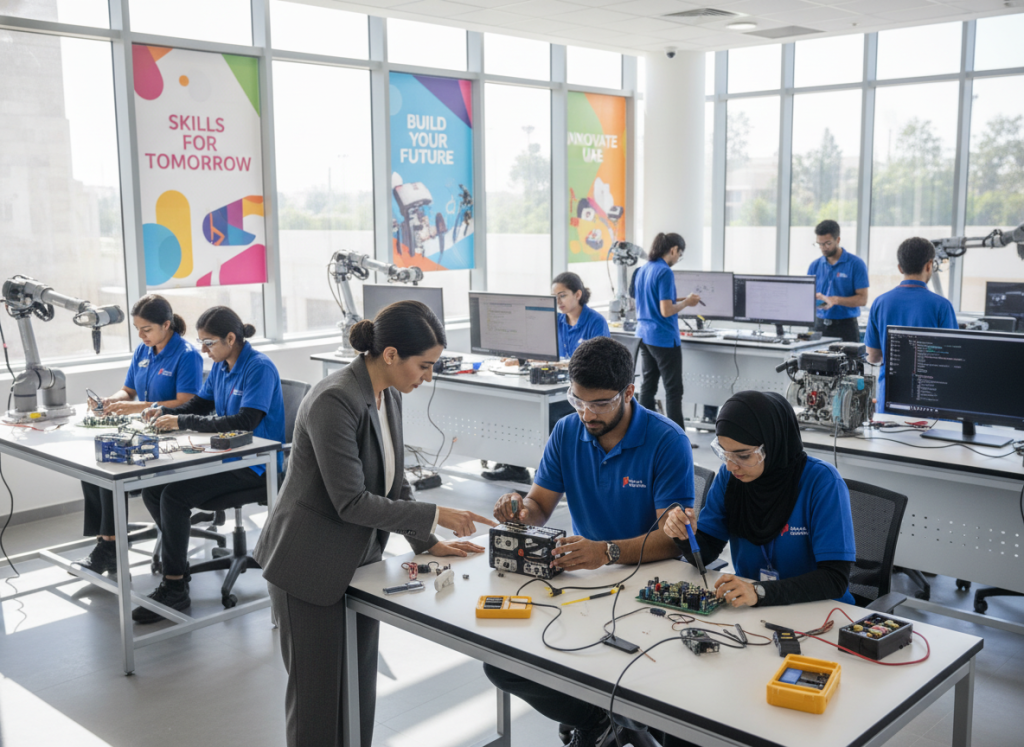
“Work-integrated learning reduces onboarding time and strengthens professional networks.”
| Route | Length | Primary Benefit | Typical Outcome |
|---|---|---|---|
| Vocational / Technical | 6–18 months | Quick, job-ready skills | Technician / trade role |
| Healthcare Programs | 1–4 years | Clinical placements, licensure | Clinical positions / nursing |
| STEM Degrees | 3–4 years | Deep technical expertise | Engineer / developer / analyst |
| Apprenticeships & Micro-credentials | Months–2 years | Earn while learning; targeted certification | Employer hire / specialist role |
- Community college and associate degrees offer cost-aware entry and stackable certification options.
- Online micro-credentials give fast upskilling but verify provider and employer recognition first.
- Industry partnerships expand internships, mentorships, and project-based learning that improve outcomes.
How to Choose the Right Path in the UAE: Requirements, Costs, Outcomes, and Timeline
Deciding on a program in the UAE should start by weighing how quickly it leads to work, what it costs, and how flexible it is. These three factors form a simple comparison lens that helps candidates match offerings to life constraints and goals.
Comparing options by time-to-employment, cost, and flexibility
Shorter programs—technical certificates and targeted micro-credentials—often speed entry into employment. They trade breadth for faster access and lower upfront fees.
Longer degrees take more time but can widen future opportunities and potential salaries. Balance the opportunity cost of a year or more against long-term gains.
How to evaluate career outcomes before you enroll
Ask for placement rates and recent job titles graduates secure. Check alumni profiles on LinkedIn and review employer-aligned job postings to sanity-check claims.
“Programs co-designed with employers reduce onboarding time and lift hire rates.”
Building experience while studying
Prioritise programs that include internships, capstone projects, or mentorship. Portfolio work, hackathons, and volunteer roles create measurable evidence of experience for recruiters.
Considering careers in schools and university administration
Teaching, counseling, and administration often require certification or graduate study. Verify licensing requirements and plan for the extra year or two some roles demand.
Future-proofing your plan
Choose programs with stackable credentials—short courses and micro-credentials that build on one another. Lifelong learning reduces risk and keeps skills aligned with a shifting UAE workforce.
Conclusion
Practical training, credible credentials, and employer alignment make the most reliable route from study into paid work.
The clearest takeaway: pick programs that convert learning into demonstrable skills through internships, project work, or supervised training. Evaluate offerings by requirements, graduate outcomes, and employer recognition rather than assuming a degree guarantees a job.
Core options covered—vocational/technical, healthcare, STEM, community college certifications, apprenticeships, and online micro-credentials—each fits different timelines and goals. Teaching and student-support careers remain viable but often need licensure, mentoring, and ongoing training.
U.S. research flags teacher shortages and early attrition and recommends mentorship and modular training as mitigations—insights worth considering when assessing any career route. See this review for more on career guidance: career decision supports.
Next steps: shortlist programs, verify credential recognition, confirm experiential learning, speak to alumni, and map a realistic timeline from enrollment to first job in the UAE.